
Cather Different
Save the date for what promises to be a refreshing approach to Willa Cather scholarship! Details about programs, speakers, event locations, and lodging are forthcoming.
Call for Papers
Cather Different
20th Willa Cather International Seminar
November 17-20, 2027
Santa Fe, New Mexico
Seminar Co-Directors: Jesse Alemán, University of New Mexico; Melissa J. Homestead, University of Nebraska-Lincoln; and Heather McClure, Chávez Library at the New Mexico History Museum
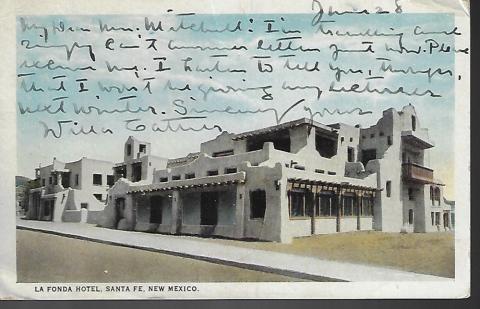
The Willa Cather International Seminar is returning to Santa Fe, New Mexico, where the conference was last held in 1990. Sometimes called “The City Different,” Santa Fe’s history as a hub of contact, commerce, conflict, creativity, and survival spans Spanish colonial rule, Mexican independence, and US annexation. Before, during, and after these settler colonial movements and in the present day, Indigenous people lived in and moved through the region’s deep history of place and its complex cultural legacy.
Our return to The City Different seeks to provoke broader conversations about what it means to read and write about Willa Cather at the current moment. Does reading Cather make a difference in our present moment, and how does our present moment challenge us to read Cather differently? How does returning to Santa Fe invoke and invite different readings of Cather’s works, including their relation to time, place, people, and history? The centennial of the publication of Death Comes for the Archbishop especially invites us to examine how to read and teach the novel–its representation of people, place, and cultural practices–in the context of a city, state, and region marked by difference. However, our return to Santa Fe also asks us to return to Cather’s writings more broadly to consider them differently for different times.
We solicit submissions for papers on a variety of topics related to Cather and her work. We welcome interdisciplinary approaches that bring history, anthropology, archeology, or art history to bear on Cather’s works and invite methodologies such as settler colonial studies, queer theory, ecocriticism, or critical pedagogies that move Cather studies in new directions. Topics for paper proposals related to the seminar theme might include:
Layers of time, place, and history in the writing, publication history, or plot of Death Comes for the Archbishop
Cather’s southwest: representation, ruins, regionalism, landscape, and the environment
Cather in relation to Anglo-American artists and writers who migrated to and visited New Mexico in the early and mid-twentieth century (Mabel Dodge Luhan, Mary Austin, Elizabeth Shepley Sergeant, D.H. Lawrence)
How do Mexican American or Indigenous writers, artists, thinkers, or teachers offer a different sense of place than the one Cather imagined in her work? How do they engage with Cather or offer alternatives to her writings?
Cather as queer, different, or non-conforming in her life, letters, fiction, or poetry
Teaching Cather differently in classrooms and communities weathering different political climates.
Cather, conservatism, and the conservative turn, then and now.
Race and Racialization in Cather’s writings in their historical context and in ours.
Mapping Cather scholarship since the 1990 seminar: How is it different now than it was in 1990, and where might Cather studies go in the future? What approaches and fields might drive Cather scholarship in different directions?
Graduate students and scholars new to Cather’s work are encouraged to make proposals. Scholarships will be available for select student presenters from the National Willa Cather Center and the University of Nebraska-Lincoln.
Scholars should submit a proposal of no more than 500 words by March 1, 2027. Proposals can be submitted by clicking "Submit Your Proposal" below and completing the provided Google Form. Decisions about acceptance to the conference will be communicated in Spring 2027. Please send questions about proposals and the submission process to internationalseminar@willacather.org.