
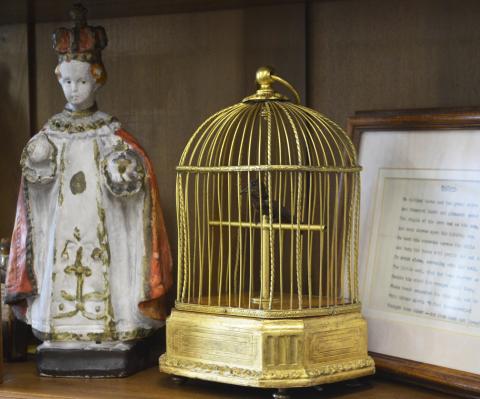
A Song Reawakened
In 2021, the National Willa Cather Center received a gift of several objects that originated from Edith Lewis’s estate, which were likely fixtures of the home during Willa Cather’s lifetime. These personal effects included a small gilded bird cage that looked both well-loved and fragile. On its car ride to the archives in Red Cloud, the archivist Tracy Sanford Tucker was startled when it burst out in loud—albeit brief—birdsong. This musical, mechanical objet d’art may have originated in France. Maison Bontems was one well-known maker
of French music boxes, snuff boxes, and singing birds-in-cages in the early 20th century. This particular piece bears no maker’s marks and is less ornate than other examples, but the distinctive knob on top of the cage points toward French origin. The hummingbird flutters its tail as the key-wound movement turns and creates whistling birdsong with a miniature pipe organ. These birds were extremely popular in the earliest parts of the 20th century, and at
least one of Cather’s acquaintances—painter Nikolai Fechin—had a similar model in his Taos home. After a painstaking restoration of the cage and feathers at the Gerald R. Ford Center in Omaha, our little bird friend is briefly on display in the research room at the National Willa Cather Center. Often these birds were outfitted with real feathers covering a brass frame, and at least in some instances were made with actual taxidermied birds—often ruby topaz hummingbirds.
Our restoration included substituting small textile infill pieces to support the original feathers to cover losses. Sadly, the fragility of the original feathers means that it’s unlikely we will be able to fully restore this piece to its working order; however, we continue to explore options to allow visitors to once again hear the beautiful song that Cather and Lewis enjoyed. The restoration was made possible thanks to our members’ support of our conservation
program.